‘China threat’ narrative a ‘complete mislabelling’, Jin Keyu says
At a recent summit, the economist said China has been a ‘benefactor’ by lowering the cost of technology for developing economies
SituationPolitics.Com
12/24/20252 min read
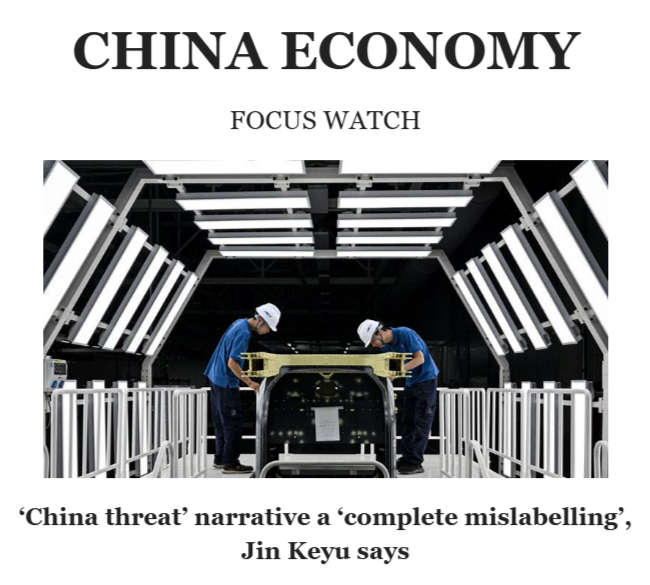
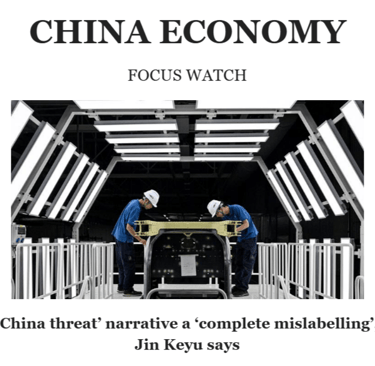
At a recent summit, the economist said China has been a ‘benefactor’ by lowering the cost of technology for developing economies
A prominent economist has dismissed the “China threat” phenomenon as a “complete mislabelling”, arguing that the country has instead supported the global diffusion of technology by significantly lowering costs through production at scale.
Speaking at a summit on Tuesday, Jin Keyu – a professor of finance at the Hong Kong University of Science and Technology – also said China’s proposals for its next five-year plan indicate Beijing recognises the need to rebalance its economy and better harmonise with the rest of the world in a process she added will require patience.
“We have to recognise that the other angle is not China as a threat, but China as a great benefactor of the diffusion of technology around the world,” she said at the Global Supply Chain Business Summit in Hong Kong.
She described China as a “huge contributor” to the proliferation of advanced technology, which she called “essential” for developing economies seeking to catch up with the rest of the world.
Jin attributed this to the country’s enormous manufacturing and innovation capacity, giving China the lion’s share of credit for the roughly 90% drop in solar panel prices observed in recent years.
She also noted Beijing’s transition to a more consumption-driven economy and efforts to curb “involution” – the cutthroat, low-quality competition that has driven down profits in several industries – reflect an awareness of a need to rebalance.
“It’s not going to be easy. It’s going to take time, three to five years,” she said. “But we also see the government trying to hold back some of the export enthusiasm and urge, because it needs to think about global harmony.
“Only under those circumstances can we really keep the global supply chain intact and resilient,” Jin said.
In a detailed proposal for China’s 15th five-year plan, released in October after the Central Committee of the ruling Communist Party held its fourth plenum, Beijing listed “expanding domestic demand” and “comprehensively addressing ‘involution-style’ competition” among its priorities.
During the summit, Jin also said the success of attempts at “decoupling” would be improbable, owing to the deep integration of the global economy.
Even after the first iteration of the bilateral trade war during Donald Trump’s first White House term, she said, US and European Union trade dependence on China continued to rise, and China’s reliance on the two economies has declined, though “China still depends a lot on the US”, she added.
Jin noted the increasing difficulty of coordinating policy between allied countries, which she said makes trade and investment restrictions “much harder to implement” and could generate a backlash.
“The harsher the imposition of blockages is, the more diversification and substitution possibilities there are,” she said.
“We see semiconductors rising to unprecedented levels of advancement in China, the mobilisation of ‘techno-nationalism’, competitors working with each other – thanks to Trump.”


info@situationpolitics.com
© 2026. SituationPolitics.Com - All rights reserved