
Trump’s Unbearable Whiteness of Being
The Supreme Court's gutting of the Voting Rights Act has cemented Trump’s legacy as the most racist president since Richard Nixon
Derrick Z. Jackson - L.A. PROGRESSIVE May 21, 2026
5/27/20266 min read
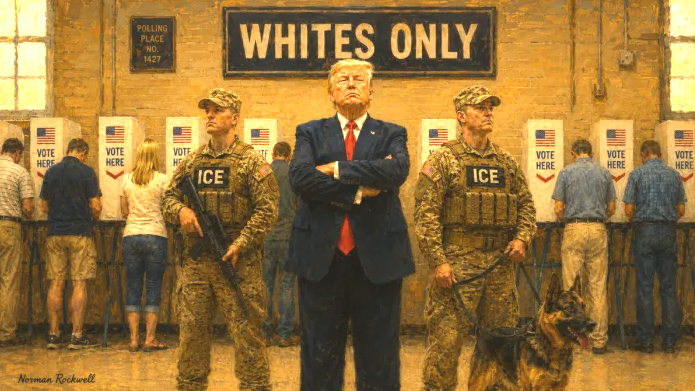
The Supreme Court's gutting of the Voting Rights Act has cemented Trump’s legacy as the most racist president since Richard Nixon
Now that the U.S. Supreme Court has hammered the last nail in the coffin of the Voting Rights Act, Donald Trump can claim responsibility for a trifecta of actions turning back the clock on civil rights.
Although Trump has not taken the country all the way back to “Whites only” water fountains or relegating Black folks to the back of the bus, the ghost of Alabama’s “segregation forever” governor, George Wallace, animates Trump’s crackdowns on immigrants and his paramilitary occupations of racially diverse cities.
The Trump-packed Supreme Court’s recent trampling of the 1965 Voting Rights Act is just the latest of his three major outrages.
The other two are the Supreme Court’s 2023 decision to ban the use of affirmative action in college admissions and Trump’s edict rolling back diversity, equity and inclusion (DEI) programs across all federal agencies.
Coupled with U.S. immigration agencies’ brutality, Trump’s trilogy will pave the way for Jim Crow 2.0.
No more affirmative action
Trump’s modern-day Jim Crow triple crown began with the June 2023 Supreme Court ban on colleges considering race and ethnicity in their admissions policies.
Packed with a conservative supermajority by Trump in his first term, the court ruled that colleges must now be colorblind.
That means the court majority willfully ignored the fact, as stated by Justice Sonia Sotomayor in her dissent, that the United States remains largely “an endemically segregated society.”
The impact of the ruling was immediate.
A February analysis by the Hechinger Report, a news organization that covers inequality in education, found that the nation’s top 85 highly selective universities—71 private institutions and 14 public ones—experienced an overall 18 percent decrease in first-year Black students in the fall of 2023, dropping from about 10,000 to 8,200.
The analysis also found that more than half of state flagships each gained fewer than 10 Black students after the Supreme Court decision, belying the claim that Black students squeezed out of elite private colleges will still be able to get into top state schools.
To rub salt into this wound, the so-called “gains” in Black and Latino enrollment at public flagships were “illusory,” according to a March Hechinger Report analysis, because many colleges claiming the most gains were the same ones that suffered massive drops in Black and Latino enrollment years ago when their states banned affirmative action.
Worse, the analysis noted that enrollment at for-profit colleges, notorious for low graduation rates and leaving students saddled with debt, collectively increased their Black student enrollment by 15,000 in 2024.
No more DEI
Next in the triad was Trump’s bleaching the government of any consideration of racial disparities, despite the fact that Black Americans still suffer disproportionately from grievous gaps in health care, housing discrimination, and proximity to pollution, just to name a few.
Immediately after taking office for his second term, Trump issued a slew of executive orders banning DEI programs across the government, terminating federal disparity data collection, and transforming civil rights offices in a number of departments into agencies that block Black advancement.
Trump also set his sights on the private sector, unleashing the Justice Department and the Equal Employment Opportunity Commission to badger companies and contractors with DEI programs that allegedly discriminate against White people.
Coupled with the ban on collegiate affirmative action, the attack had a chilling effect on corporate diversity programs, undermining any progress made in the wake of George Floyd’s murder by Minneapolis police officers.
The percentage of the top 100 companies on the New York Stock Exchange whose human capital management disclosures included the term “diversity,” for example, plummeted from 96 percent in 2024 to just 36 percent a year later.
At the same time diversity programs began to disappear, jobs for Black people evaporated, whether by coincidence or causation.
Start with the federal government, which has long served as a refuge from employment discrimination.
In fiscal year 2021, Black women accounted for 12 percent of the federal workforce compared to 6.6 percent of the overall civilian labor force.
Black women suffered 35 percent of the 271,000 job losses as a result of Trump’s massive contraction of the federal workforce, according to the Economic Policy Institute.
In the overall workforce, Black women—who comprise 14 percent of all female workers—accounted for nearly 55 percent of U.S. women’s job losses from February through December 2025, according to the Institute for Women’s Policy Research.
While not as dramatic, Black men are also experiencing lower employment.
Black unemployment in general has increased significantly during Trump’s second term while White unemployment has been flat.
In February 2025, Trump’s first full month back in office, Black unemployment was at 6 percent compared to 3.8 percent for White workers.
Last month, Black unemployment was 7.3 percent, while White unemployment—despite all the economic chaos resulting from Trump’s war and tariffs—has remained relatively stable at 3.7 percent.
By contrast, at one point during the Biden administration, which promoted DEI initiatives as well as major jobs programs, Black and White unemployment rates reached a low of 4.8 percent and 3.1 percent respectively.
It was the only time the Black unemployment rate dropped below 5 percent in the last two decades and represented Black workers’ closest parity to their White counterparts.
Under Trump, Black unemployment has jumped back to double that of White workers.
No more Black representation
The Supreme Court’s April 29 Louisiana v. Callais ruling is the third installment of Trump’s racist trifecta.
The high court declared that states must provide proof of “intentional” racism to consider race when drawing legislative district maps.
The result? Southern states are now tripping over themselves to add Republican congressional seats by redrawing maps to carve up Black urban districts, accelerating a process that had already begun in Missouri, North Carolina and Texas.
On May 11, the court issued a subsequent decision allowing Alabama to use a new congressional map that will likely eliminate a majority Black district.
The Louisiana v. Callais decision also clears the way for White racial gerrymandering at local, county and state levels of government all the way down to school boards.
Black Voters Matter Fund and Fair Fight Action predict the ruling could result in 191 more GOP seats in Southern state legislatures as well as 19 more Republican U.S. House members.
Meanwhile, the Democrats’ attempt to return the favor in blue states took a major hit when the Virginia Supreme Court threw out a map that would have added four Democratic seats in Congress and the Supreme Court rejected an appeal by Democrats to reinstate it.
Trump’s success in boosting White advantage in voting, education and employment has been consequential enough that his supporters are willing to overlook his failure on the main issue they claimed drove them to the polls.
Trump’s success in boosting White advantage in voting, education and employment has been consequential enough that his supporters are willing to overlook his failure on the main issue they claimed drove them to the polls.
In the run-up to the 2024 election, 93 percent of his voters said the economy was their top issue, but Trump is not doing too well on that score these days.
In a late April Reuters/Ipsos poll, only 52 percent of Republicans approved of how he is handling the cost of living.
Even so, his overall job approval rating among Republicans is still in the stratosphere.
In late April, they gave him an 85-percent stamp of approval in a Washington Post/ABC News poll.
What explains that 30-point gap?
Despite cratering the economy with his on-again, off-again tariffs and his costly, unnecessary war, Trump still enjoys strong Republican support when it comes to issues related to immigration and crime, which have long been proxies for controlling people of color.
In that same Washington Post/ABC News poll from last month, Republicans gave Trump an 88-percent approval rating for his handling of immigration and 89 percent for his handling of the border.
Meanwhile, an NPR/Ipsos poll from last September found that 78 percent of Republicans applauded Trump’s deployment of the National Guard in Memphis, Washington, D.C., and other cities with large Black populations, even though crime in those cities has been falling since the spike during the pandemic.
By comparison, only 38 percent of all poll respondents approved of the deployments.
Republicans also have no problem with the impact recent Supreme Court voting rights decisions will have.
Earlier this month, an Economist/YouGov poll asked respondents about the importance of proportional Black congressional representation.
While 83 percent of Black respondents said Black representation is very or somewhat important, only 47 percent of Whites and 25 percent of Republicans agreed.
The illusion of White superiority
Donald Trump has succeeded like no other modern politician in getting his supporters to embrace the illusion of White superiority so he can swindle them.
Vice President-elect Lyndon Johnson explained how that works to his aide Bill Moyers back in 1960. “If you can convince the lowest White man he’s better than the best colored man, he won’t notice you’re picking his pocket,” said Johnson, who as president strong-armed Congress into passing the Voting Rights Act.
“Hell, give him somebody to look down on, and he’ll empty his pockets for you.”
Six decades later, White Republicans have once again fallen into that trap, in flagrant disregard of Martin Luther King Jr.’s warning about de facto segregation.
“There can be no separate White path to power and fulfillment,” King said, “short of social disaster.”


Derrick Z. Jackson, a former Union of Concerned Scientists fellow and Boston Globe columnist, is a regular contributor to Money Trail.
info@situationpolitics.com
© 2026. SituationPolitics.Com - All rights reserved